Skip to content

Your Málaga travel guide

When to go, where to stay, how to get there and what not to miss, from the people who live here.

Bougainvillea in bloom over a white gate in Málaga

When to go to Málaga

According to AEMET, Spain's weather agency, Málaga gets around 2,900 hours of sunshine a year and an average temperature of 18.5 °C, with mild winters. Spring (April to June) and autumn (September and October) are the best time to combine city, day trips and beach without the summer heat. June to September is peak beach season, livelier and hotter; the Feria de Málaga takes place in August. Holy Week is also a big event, so book early.
Málaga port at night, with the Ferris wheel and the cathedral behind

Where to stay

The Old Town and Soho are for those who want to walk to the Alcazaba, the Cathedral, the Picasso Museum or the Centre Pompidou. La Malagueta is the city beach, a stroll from the port. Pedregalejo and El Palo, to the east, feel like old fishing quarters, with beach restaurants and a seafront promenade. If you want more space, a pool or a garden, the Costa del Sol and the inland villages have larger homes within an hour.

Ships moored in the port of Málaga

Getting there and around

Málaga-Costa del Sol airport is a few kilometres from the centre: the C1 commuter train reaches Centro-Alameda station in about 12-15 minutes, and there are buses and taxis too. María Zambrano station receives the high-speed trains from Madrid in about two and a half to three hours, depending on the train. In the centre you can walk or take the city bus and metro; parking is hard. For the coast and the inland villages, a car is the easiest option. Always check current timetables on Renfe before you travel.

La Malagueta letters on the sand, with palm trees behind

Beaches

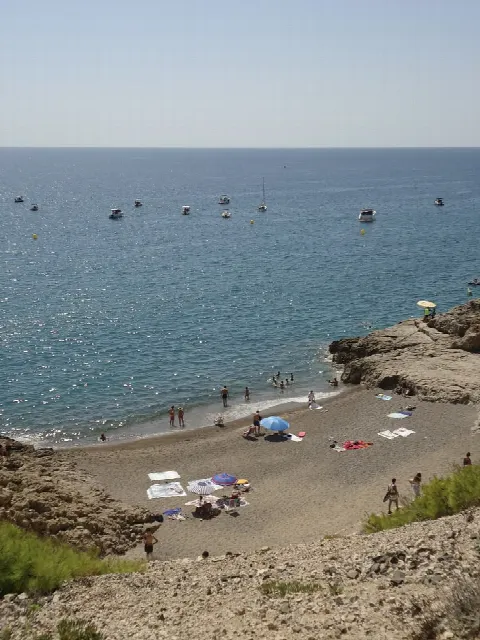
In the city itself, La Malagueta, La Misericordia, Pedregalejo and El Palo. To the west, Torremolinos, Benalmádena and Fuengirola; to the east, the coves of Rincón de la Victoria and Nerja. Many have beach restaurants where you can try espeto, grilled sardines on a skewer.

The Alcazaba of Málaga above the Roman theatre

What to see and do

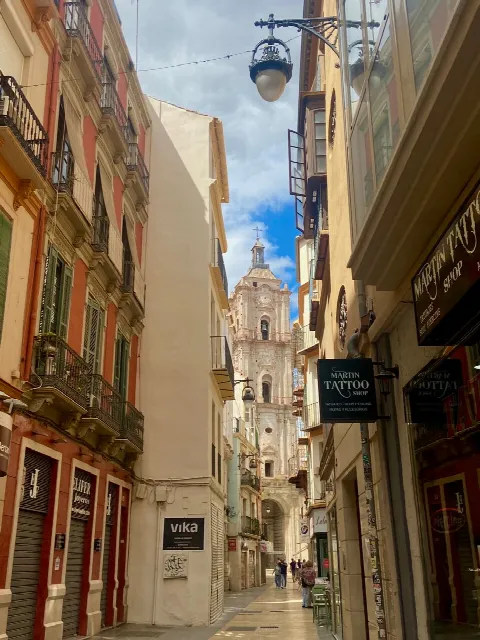
The Alcazaba and Gibralfaro castle watch over the city; the Cathedral, the Picasso Museum and the Centre Pompidou complete the cultural visit. Beyond the city, white villages such as Frigiliana, Ronda and Antequera, and the Caminito del Rey (book your ticket in advance), are classic day trips.

Grilled sardines with salad

What to eat

Espetos (grilled sardines), fried fish, ajoblanco (cold almond soup), porra antequerana and sweet Málaga wine. Every neighbourhood has its spot: tapas in the centre, fish in Pedregalejo and El Palo.

Orange tree with Christmas lights in Málaga

Málaga in winter

Winter is mild: in December and January the average temperature is around 12-13 °C according to AEMET, and on many days you can eat outdoors. It is a good time to explore the centre without the heat, see the Christmas lights on Calle Larios and walk in the hills and white villages.

Family walking along the shoreline

Málaga with children

The beaches in the city and along the coast have promenades and beach restaurants, and for days off the beach there is Bioparc Fuengirola or the Benalmádena cable car. If you travel with children, look for a home with a pool or garden and ask for a cot if you need one: each listing shows what the home has.

Person working on a laptop on a terrace overlooking the sea in Málaga

Working remotely from Málaga

More and more people come to Málaga to work remotely: it has direct flights to much of Europe, the same time zone as Paris or Berlin (one hour ahead of London) and good weather most of the year. Each listing shows whether the home has Wi-Fi and a workspace; for stays of weeks or months, just ask.

Our stays by destination

Updated November 2026. Climate data: AEMET, Málaga Airport station (1981-2010 normals). Trains and timetables: Renfe. AEMET · Renfe Cercanías Málaga

View all stays Experiences in Málaga